31 October 2012

Halloween Greetings...


Ellen Leonard


Arthur Rackham


                   The Haunted Chamber 
                 Henry Wadsworth Longfellow

                    Each heart has its haunted chamber,
                   Where the silent moonlight falls!
                    On the floor are mysterious footsteps,
                    There are whispers along the walls!

                  And mine at times is haunted
                  By phantoms of the Past
                 As motionless as shadows
                By the silent moonlight cast.

                A form sits by the window,
                                That is not seen by day,                 
                    For as soon as the dawn approaches
             It vanishes away.

                It sits there in the moonlight
              Itself as pale and still,
                 And points with its airy finger
              Across the window-sill.

                Without before the window,
                 There stands a gloomy pine,
                  Whose boughs wave upward and downward
                   As wave these thoughts of mine.

             And underneath its branches
             Is the grave of a little child,
             Who died upon life's threshold,
             And never wept nor smiled.

             What are ye, O pallid phantoms!
             That haunt my troubled brain?
             That vanish when day approaches,
           And at night return again?

              What are ye, O pallid phantoms!
              But the statues without breath,
             That stand on the bridge overarching
             The silent river of death?


07 October 2012

Arntzmobile...


Gerd Arntz was the German artist and graphic designer responsible for creating the pictograms of Isotype, The International System of TYpographic Picture Education developed by Viennese social scientist and philosopher Otto Neurath.  Isotype was a means of visually representing complex statistical information - the generic pictograms were typically used to illustrate stylized charts explaining economic and political data.   Isotype marked the inception of modern visual statistics, establishing a clear means of communicating to ordinary people esoteric information that was often difficult to understand.  In addition to the uniform human symbols, Arntz created pictograms for ships, automobiles, food, plants and factories.   Among the over 4000 symbols Arntz designed were these, my favorites, unsurprisingly: images of animals wild and domestic. 


These are wonderful images, and, quite unlike the majority of human figures he created, vivid and dynamic.  Not only are they examples of good design but they're cheerful and deserve to be seen.  With a little cardstock and some thread, I fashioned this mobile of woodland creatures - Rabbit, Squirrel, Frog, Mouse.  


If you're interested in seeing more of Arntz's work, the Gerd Arntz Web Archive is the place to start. There, you can also download the Gerd Arntz Memory App which is indeed a very pleasant brain-enhancing distraction.   And do spend some time meandering around the Gerd Arntz Archive from the Museum of the Hague.  Here are a few images to tempt you...


13 September 2012

"the noblest of fruits..."


Conradus Schlapperitzi, Bible History, 1445


...or so thought Henry David Thoreau when writing his glorious paean to the apple, entitled Wild Apples, a meticulous account of the history and habits of both "civilized apple-trees" and those old, ungrafted trees which do not bear the burden of domestication.  Published by The Atlantic in November 1862, it was one of three articles commissioned by the magazine toward the end of Thoreau's life.   It is fascinating to read and a pleasant reminder that now is, indeed, apple picking time.  If this is precisely the sort of joy-making diversion that tempts you out-of-doors, a wonderfully helpful site, Orange Pippin, can direct you to over 2000 orchards in the United States as well as locations in Canada, the UK, India and Europe.  The site also provides (!!) an extraordinarily comprehensive A to Z directory of varieties you perhaps have not heard of, from the sweet and fruity Swiss Api Etoile, introduced in the 1600's, to an 1885 cultivar, the German Zabergau Reinette, a strong russet with the intriguing taste of nettles!


Educational plate, 1902


Leonard Leslie Brooke, The Three Little Pigs, 1904


Arthur Rackham, Hi, You Up There, 1915


Apple vendor, Boston Common, 19th c.


Kate Greenaway, A Apple Pie, 1886


(Images courtesy of NYPL Digital Gallery & Vintage Printable.)

21 July 2012

long live the Queen...


Today, we're celebrating Foof's ninth birthday.  Since learning of the date a few years ago, I've created announcements proclaiming the glorious occasion - this year's inspiration is that other Queen's Jubilee.  After greeting in a distinctive manner some neighboring cats who came to pay their respects, HRH tucked into her favorite repast, a chicken and duck pate with a refreshing salad of oat grass.  She accepted, with typical grace, my apologies for being unable to stage, in her honor,  a stately, floating procession of gayly bedecked craft and instead, enjoyed a few moments in the bathtub.   On the advent of the next year of her triumphant reign, she is as majestic, clever and beautiful as one could hope for.  For a celebratory treat, she asked to hear the recitation of a favorite passage from ChaucerShe is now resting, having exhausted herself over a tin of catnip sardines.
Vivat Regina, dearest Foo Foo, long may you live!


Mice Before Milk
 
Lat take a cat and fostre hym wel with milk
And tendre flessch and make his couche of silk,
And lat hym seen a mous go by the wal,
Anon he weyvith milk and flessch and al,
And every deyntee that is in that hous,
Suich appetit he hath to ete a mous.
 

from The Manciple's Tale
Geoffrey Chaucer


16 June 2012

Bob...


When Bob arrived in August of 2007 it was in a dull red carrier from which he refused to move.  I  put in a friendly hand to say "hello" and was bitten, not severely, but decidedly.  He had just endured a long car ride and fearful of a new place, was not yet prepared to tolerate a stranger.  When his former mum left the following morning, poor Bob was at the top of the stairs, pulling pieces of fur from his hindquarters.  Foof, who had also suffered the trip, was in hiding, sulky and petulant under a bed somewhere and of no help to him whatsoever.  Gradually, he began to settle in.  Some months later, both cats came to live with me.  Again, he was terrified, disappearing entirely to some unseen empty space in a cabinet and causing a complete panic that prompted a preposterous outside search and then absolute incredulity when his hideout was revealed and he was discovered, quiet and baleful and forlorn. 

The challenges of another transition soon passed and he and Foof took to their new home fairly quickly.  I could see their relationship was primarily based on a polite mutual tolerance.  I think they regarded each other as competition for resources: food, territory, my affection.  They rarely argued, although on those very few occasions when they became occupied with fighting and biting, it was typically she who was the aggressor.  Only once did I see Bob bully her.  His choreography was eloquent.  Bob's shape was unusual for a cat - he was quite barrel-chested and so convincing as a thug while persecuting her for some offense.  After cornering her and looming in a large and manful way, he retreated to the berry box which she used as a nest from time to time.  With that glow of serene righteousness that the wronged experience when - at last! - favored by Justice, he flooded her lair with an abundant stream of urine.  Having put things right, he marched off, triumphant and as happy as I'd ever seen him. 

He liked cookies.  He liked pastries.  He liked popcorn and potato chips.  He liked hand cream.  He was rarely permitted access to such goodies, but when in the presence of any of these treats, he assumed a look of hopefulness and was usually rewarded with a fraction of a fraction of something sweet or salty.  The hand cream was not given as a treat, but Bob was a licker and if he could ambush you emerging from the shower he would pursue like a tiger on the prowl until picked up and kissed and lavishly complimented on being such a sweetie and it was then that he would seize you in his paws and devour as much after bath moisturizer as he could consume before being wrestled from the banquet of unguents.   I also quite recently observed, and preempted, I must add, his fondness for spray starch. 
 
I don't think any of the photos of him on this blog made clear the reason for his name.  He was a bobtail - either a rumpy riser or a stumpy, I haven't yet worked out which.  He had a little black stump of a tail that would blossom into a black puff at the sight of some strange cat.  Along with his bandit mask and his oddly shaped feet, (he had unusually large "heels" that enabled him to stand like a human, with his enormous back feet flat on the floor), the little tail was one of his most endearing traits.  That and his quiet stoicism and aura of pure and enduring goodness.  In his dotage he became a talker.  "Rrrrrowwww" was his favorite word but it had very many variations and it was generally only used for the benefit of humans. 

At times, Bob was quite possessive, but then, so is Foof - perhaps it's the nature of cats.  I have always had pots of fresh cat grass and catnip for the enjoyment of both beasties but the catnip always belonged to Bob.  He would often try to prevent Foof from having any by sitting in the pot and squashing it all flat.  Often, he liked to play with his toys but with one paw securing the nip.  It was quite a dilemma.  Bob wanted to have all the toys, too. 

Last week, over the course of a few days, Bob stopped eating.  He had Chronic Renal Failure and was being treated with various nutriceuticals with apparent success.  But at 21 years old, he was giving out.  I've lived with nine cats during my life and the ones who have become demonstrably sick have done so almost overnight.  They are fine one day and then the next they're not fine at all.  It was like that with Bobcat.  By last Friday, he could barely walk.  It was agonizing to watch.  For the last couple of years I have awoken every day wondering if Bob would still be alive.  Astonishingly, he always was.  I had hoped he might die quietly in his sleep and I would discover him still and at peace,  but instead he began to suffer outwardly and I had to finally make the decision to end his suffering.   When we lose our animal friends, we are often overcome by the strength of our grief - grief that is proof of our love.  That part of our hearts animals claim as theirs alone is much greater than we imagine when we choose to share their world.  Bob was a kind and loving soul.

We made the trip to the hospital at noon on Saturday with Bob in his dull red carrier lined with a soft blue blanket.  In the back seat of the car, I opened the carrier to pet him.  He looked at me, put his paw on my hand and began purring.


06 May 2012

Morris Hirshfield's cats...

It seems that even in my young days I exhibited artistic tendencies...begins the biography of self-taught artist Morris Hirshfield (1872-1946) who immigrated from Poland to the United States when he was 18. Forgoing his artistic calling to make way for the more practical matter of earning a living, Hirshfield settled in New York City where he found employment in the garment industry and later established with his brother a slipper making business known as the EZ Walk Manufacturing Company.  Together, they produced high quality ladies' "boudoir slippers" until poor health forced Hirshfield to retire in 1935.  In 1937, at the age of 65, to the amazement and consternation of his family, he returned to painting.  Women and animals were frequent themes.  He struggled to give form to his vision.  It seems that my mind knew well what I wanted to portray but my hands were unable to produce what my mind demanded.   His work was discovered in 1939 by art collector and gallery owner Sidney Janis, who selected two paintings to be included in an exhibit called "Contemporary Unknown American Painters" at the Museum of Modern Art.  In his collection of biographical studies of self-taught artists entitled, They Taught Themselves: American Primitive Painters of the 20th Century, Janis describes his first encounter with Hirshfield's work; the image below - this exceptional, preternatural cat.

 Angora Cat, 1937

About to leave the gallery, I peeked at a picture whose face was to the wall.  What a shock I received!  In the center of this rather square canvas, two round eyes, luminously gleaming in the darkness, were returning my stare!  It brought to mind the sequence in Duck Soup in which Groucho Marx, confronted by an unexpected image in his mirror, was taken aback, only to find the image oddly enough immobile.  The image I saw was just as unexpected and the round unflinching eyes continued to stare, impervious to my sudden start.  They belonged to a strangely compelling creature which, sitting possessively upon a remarkable couch, immediately took possession of me...

Janis goes on to describe "her" with great affection:

Angora Cat is a strange mysterious creature.  She is at once spell-binding and mirth-provoking.  Her deep-set eyes, staring intensely, take immediate possession of the beholder, and they hold him with the suspense of a mystery thriller.  But she is such a homey creature, round and fluffy, that the terror is not quite convincing, and the ripples of fear that run up and down  the spine eventually turn to laughter.  She is an exciting, upsetting creature, whom one cannot help but love. 
 

Cat and Two Kittens, 1945


 Leopard Family, 1943


 Mother Cat With Kittens, 1941


Cats in the Snow, 1946


 Tiger, 1940


 Lion, 1939


Hirshfield subsequently became one of the most prominent American folk artists of the 20th century producing seventy-seven works between 1937 and 1946.  Several of his paintings are included in  MOMA's permanent collection.  Although I've known of his work for many years, these paintings have become one of my newest obsessions.  Perhaps it's just a symptom of my feline monomania, but I think these images are completely thrilling. 

29 April 2012

charm...


Inspired by those fetching Depression era plates my mother had carted home, I purchased this, an emerald green glass teacup in the Fire-King brand Charm pattern produced by Anchor Hocking from 1950 through 1956.  This marked the beginning of a fairly brief but passionate interest in acquiring as much Fire-King glassware as I could afford.  I now have a lot of it.  If ever I needed to preoccupy myself with the sort of purposeful wish-fulfillment that might bring down to a simmer a roiling cauldron of deeply seated uncertainties seasoned with existential dread than this was it.  Isn't that why people collect things?


Anyway,  I properly fell in love with this.  This green color was known as Forest Green and was never officially designated as a part of the Charm line which was typically associated with the colors Jadite and Azurite.  Fire-King was inexpensive and utilitarian.  It was given away in bags of flour as a promotional item or could be purchased at the grocer's or the gas station. 
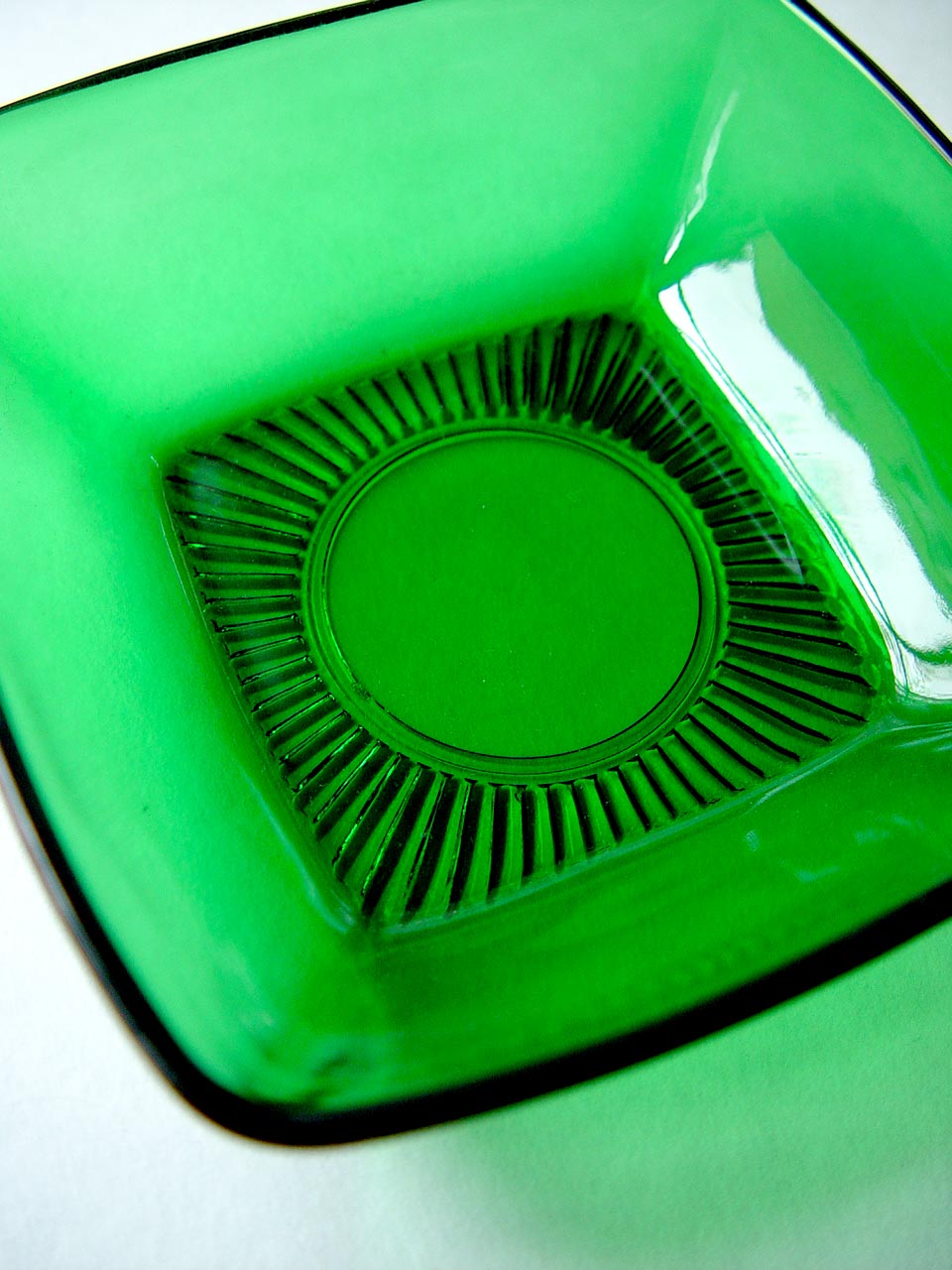


There were eleven pieces in the Charm pattern.  Above is the dessert bowl.  I'm not entirely sure why I was so taken with this green.  I almost never use it.  I know some collectors put this out at Christmas, but I have never been susceptible to the arbitrary social constructs that require me to wear red for Valentine's Day or  green for St. Patrick's Day, so I will not be exhuming this for festive holiday use. 


Here's an example of the same pattern in Azurite, an icy barely-blue.  I do find this rather more appealing than the green. 


Charming as Charm was, I was fairly quick to spot the design flaw.  It's not always a simple matter to drink from square teacups.  I graduated to the conventional form with this Turquoise Blue line produced between 1956 and 1958.  It was promoted as dinnerware but marked Oven-Ware which meant you could pre-warm your glass before serving, as you do.  There are sixteen pieces in this line.


A Fire-King mug with the "D" handle.  I believe the "C" handle is somewhat more collectible.


I really do love this, the cup and saucer from the Restaurant Ware line made from 1948-1967.  I have several sets.  This is real hairy-chested man stuff, heat-proof and made specifically for mass feeding establishments. It was billed as "highest quality restaurant ware at popular prices" - $2.00 for a box of one dozen cups, $3.30 for one dozen dinner plates.


I know what you're thinking - why does our gentle author have so many cups and saucers?


I suspect that this has something to do with it - this is just a fraction of my grandmother's collection of quaint porcelain teacups.  She had an astonishing number of these, all beautifully arranged on a cupboard that spanned the width of a wall.  She collected these as well as porcelain shoes and vividly glazed pottery turtles.   I suppose my impulse toward collecting is genetic and nostalgic in equal measure.  


Here, a lovely piece of Dresden.   Compared with  the modest Fire King, this is a radiant Leslie Caron in a hat.  On the Champs-Elysees.  With Louis Jourdan, naturellement. 


Then, there was this - Swedish Modern.  Yes, Charm was charming but why settle for charming when you can cosy up with irresistible?  Oh Swedish Modern, how do I love thee?  Let me count the ways.  You're beautiful, you come in this gorgeous robin's egg blue, your design is perfect, you elegantly do the job you were designed to do, if life consists of pouring batter into a cake pan, then yes, you make life easier and you're called Swedish Modern, which just breathes "mid-century" and decorates the mind with images of beautifully handknit apres-ski togs, and Arne Jacobsen Egg Chairs, even though he was Danish,  and young, fresh uncomplicated people who enjoy life and eat full-fat dairy products.   


A mixing bowl in the Swirl pattern.  It's back to America and the Ohio River Valley with this - more prosaic, less design-y and inspirational, but delightful nonetheless.   More Betty Crocker and less Liv Ullmann.  Who was Norwegian.