21 July 2011

now we are Eight...


Today, Foo Foo turns eight. She has lived with me for four years. She is a smart and beautiful purebred Maine Coon with a documented provenance, so to speak, and last year I received her papers from her former human mum. I was thrilled to learn her birthdate and her original name, Peconic Quwtie Pie, and decided to send out birthday announcements to a few cat-loving friends and acquaintances. As is typical of Maine Coons, she is determined to have her own way. Last year, the birthday girl chose to spend the better part of her special day asleep on a porch with her head in a shoe. This year's celebrations may be similarly low-key.

For those not familiar with this breed, the Maine Coon is frequently referred to as a "gentle giant".   At around 16 pounds, Foof is a mighty big girl, but to consider her gentle, one must pass helplessly into a dimly lit realm of myth. I learned very quickly that, darling as she is, she can also be bossy, saucy, possessive, and unpredictable. Any thing that you might have, a book, for example, an article of clothing, your keys, becomes hers on a whim and once hers, it is not surrendered graciously. Because her behavior is adamantly contrary to the sweet geniality associated with Maine Coons, I became curious.  That led me to genetics.

Here's a color version of the Beastie:


As you can see, she's patched, or blotched, with ginger and grey. Her papers identify her as a "Patched Tabby with White", which is another way of saying she's a Tortoiseshell or Torbie.  Although her paws and ruff are white, technically, she doesn't have enough white to be called a Calico which should be at least half white. As many vet techs and veterinarians, shelter workers and loving owners can attest, Foof and those cats whose coats are similar to hers are infamously known as Naughty Torties.

Sometimes it's called "Tortitude".   I was actually speechless when her veterinarian, a delightful woman of  thoughtful tact and diplomacy, said Foof had "the Demon Gene", a characterization that seemed rather too colorful.   I will certainly admit that her behavior can be ... difficult, at times, but I adore her no less for it.  To me, she is perfect.  In fact, as my perception of her is mired in some thick aspic of love and affection,  I think it only enhances her many charms.  I'm not alone.  A visit to the tortie page of a cat behavior website confirms this with comments like,

"She's a holy terror at the vet's"

or,

"She has strong "preferences" about how things should be done, such as the perfect drip speed for the bathtub faucet. But she is never mean--she's just an independent thinker."

or this,

"I have to admit she does have a bit of tortitude, but it doesn't help that I spoil her. She can be very bi-polar at times. One minute she's purring as you pet her; the next minute she's biting your hand for no apparent reason."


Notice the common theme here: "she".  Torties and calicos are normally females.  Here's where a rudimentary genetics lesson is useful.   Females have two X chromosomes, males have one X and one Y chromosome.   Coat color is a sex-linked trait associated with the X chromosome so females inherit two color genes, one from each parent.  Males inherit only one.  The feline color genes that occupy the X chromosome are identified as either orange, "O" or not-orange, "o".   If the female cat inherits only one "O" gene, the non-orange "o"  patches will be expressed as some shade of black and her coat has tortoiseshell coloration. The predominant whiteness of calicos is  known as "piebalding".  It is caused by a white spotting gene which results in large patches of unpigmented fur.  Messybeast  is a UK based site with lots of good information about feline genetics and many other cat-related topics.   For a clear and entertaining explanation about coat color and the story of the genetically anomalous calico male named George, seek out the picturesquely titled, Cats Are Not Peas by Laura  Gould.

But what about the tortie reputation for difficult behavior?  Is there a connection between coat color and temperament or is this just a byproduct of accrued human prejudice?  My research so far has been  intriguing.   Numerous studies have demonstrated a link between coat color and temperament in cats, dogs, foxes, mink, rats, deermice, and fallow deer.  The association does not imply that coat color is responsible for behavior but rather that hormones and neurotransmitters involved in the way an animal experiences stress are closely connected to pigment production.  Investigate this site for a more thorough explanation.

Since we know the year but not the exact date of Bob's birthday, I'm choosing to honor him today as well.  He is in the initial stages of Chronic Renal Failure, the kidney disease all too common in cats.  He is being treated with a product called Rubenal, more familiarly known as medicinal rhubarb root. He is feeling much better.


A postscript: Foof's eight happy cat years equal 48 human years.  Bob's age is twice that: 96.

Update:  September 2012 findings from a new study on feline genetics reveal that cheetahs and domestic tabbies share a mutation responsible for blotched coat patterns.

13 June 2011

inventory...


As is typically the case, any time I set out to locate some thing I haven't seen for years but think I absolutely must find, I run across another thing, wholly unanticipated and invariably more interesting than the thing I was determined to find in the first place.   This time I unearthed a tin that used to contain Grether's Blackcurrant Pastilles, a treasured commodity that in recent years has become so scarce and stratospherically expensive that it will be a long time before I make this a staple of my diet again.  Just as well.  Inside, I found something perhaps more dear...


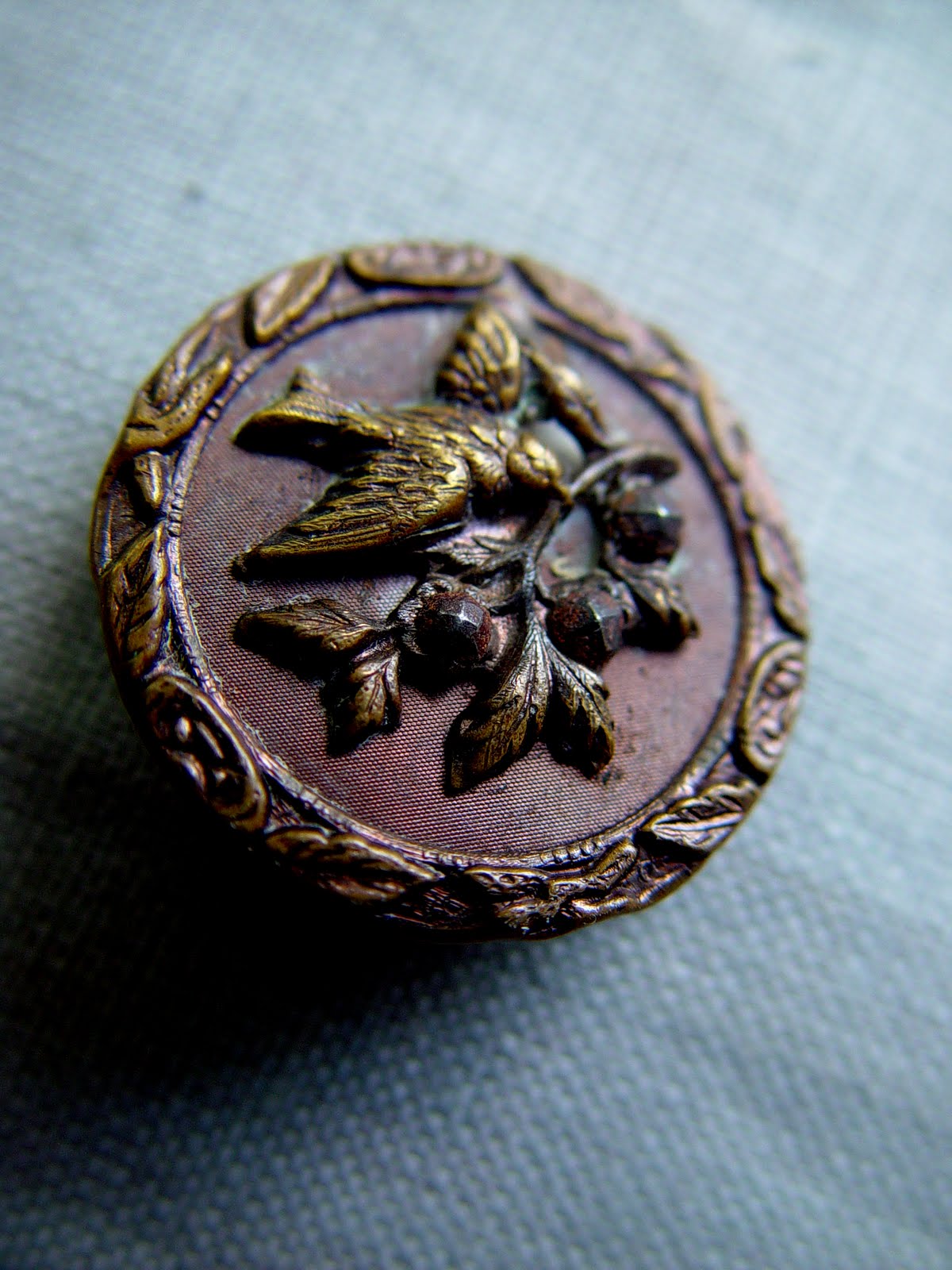
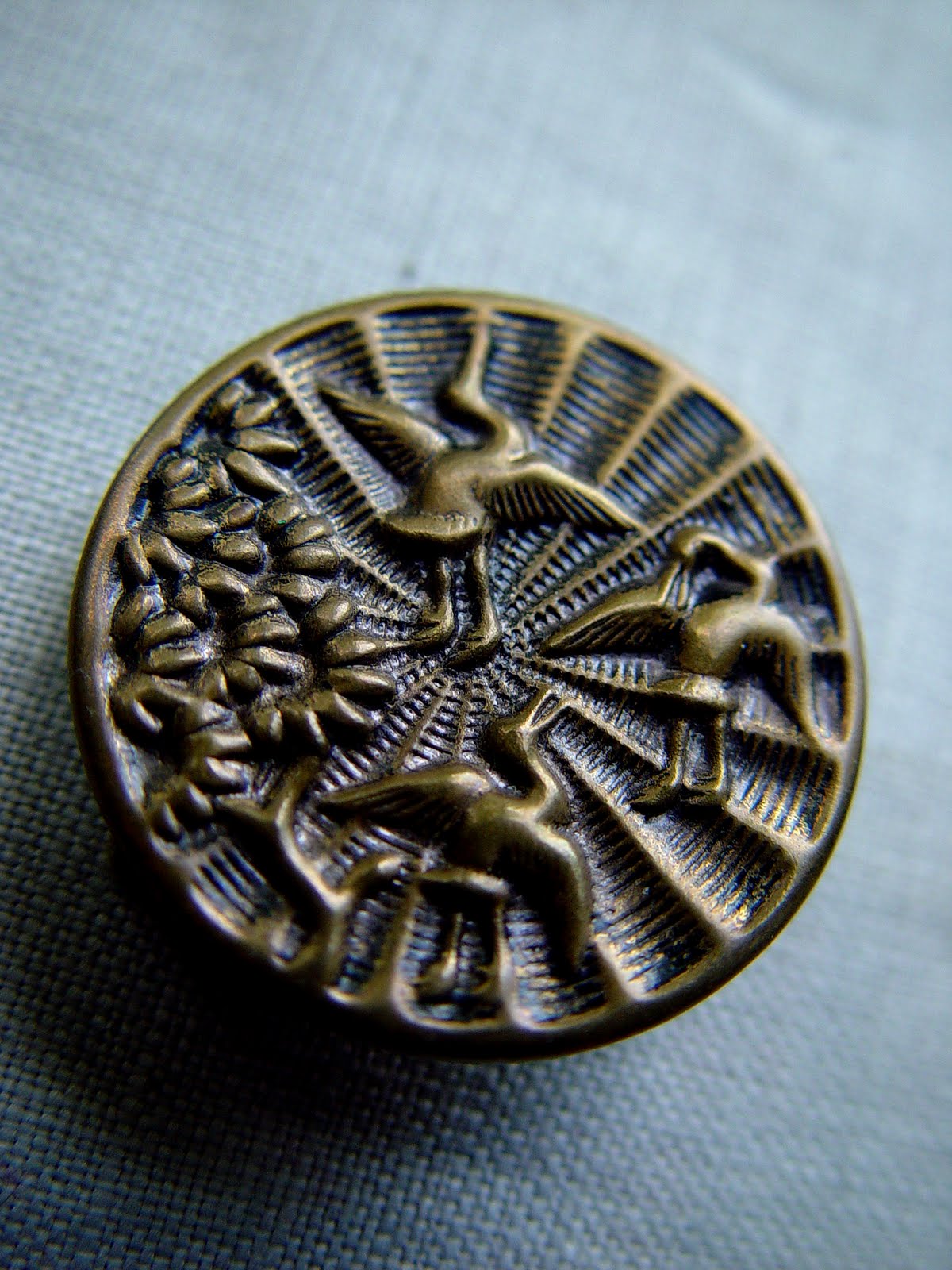
...more buttons from my grandmother's collection.  I vaguely remember squirrelling these away because they were the few examples that were decorated with animals and they are pretty fantastic. There are some lovely images of fruit and flowers as well. 


Beautiful enamel work.


This button strikes me as quite old.  The central disk is velvet.


04 June 2011

experiment...

First, one thing needs to be clear: I know nothing about quilting, but I'm fascinated by nontraditional quilt design and some recent visits to contemporary quilting blogs have inspired me to give it a go.  Realistically, I can't qualify my rudimentary efforts as "quilting". Better to call it "patchwork" even though "aimlessly sewing together strips of fabric" is really more to the point.  I have long admired the work of Denyse Schmidt with her use of striking color combinations and seemingly improvisational piecing.  I like that minimal, unfussy look, although I've since learned that her technique is anything but impromptu.

There are two other things that I must admit.  1:  I am guilty of the most strenuous and disabling overthinking.  It's a self defeating tendency I'm determined to exorcise.  2:  I have a substantial cache of fabric that I've collected impulsively without any purpose other than to take home material I really like.   None of it is designed to work together, but I seem to have acquired quite of lot of blue, a habit I'm trying to curb.

Here are my first attempts.   Those of you who are experienced quilters may feel the need to avert your eyes.  But, I have to say, I really enjoyed myself and I'm rather pleased with this first modest effort. 


Postscript : This...is...positively...addictive!


30 May 2011

Nature Magazine...


I picked up a couple of copies of Nature Magazine from the Big Chicken Barn outside of Ellsworth, Maine.  I think the cover illustrations are charming, but can find almost no information about the artist.  The vignettes are signed "Hexom".  There are no credits on the contents page and all I've turned up so far in my online research is a few mentions on some used book sites of a Bronson Hexom who did create illustrations for Nature.   At the moment, I've no further clues, so if you know anything about this artist, I'd love to hear from you.


The identity of the artist who created this
quite attractive owl is also a mystery.

24 May 2011

Floraline redux...


 I found a few more pieces of Floraline this weekend.


I was ambivalent about buying this one.  I really like that murky green, but I've learned that the white examples are harder to find so I gave in.  Besides, it's an early piece in mint condition and the woman I purchased it from was perfectly lovely.  If I don't consign it to decorative object status, I think it might do quite well as a kibble trough.  Apparently, it's the ideal shape for reducing "whisker stress".


 A later piece, produced after Lancaster Colony Corporation
took over McCoy in the 1970's.


I really love this one.  It has the same serene 
simplicity as the vase I purchased last week.

21 May 2011

object :: McCoy Floraline Vase


I recently found this at a thrift shop and couldn't leave without it.  It's a Floraline vase, produced by the Nelson McCoy Pottery in the late 1960's and designed specifically for the florist's trade.  The Floraline line is quite varied, with quasi-Classical urns and elegant tall vases as well as the simpler bowl shapes.  The Floraline esthetic was designed to unobtrusively compliment rather than detract from floral creations.   The configuration of the mark suggests that this vase was made after 1967, when McCoy became a subsidiary of Mount Clemens Pottery.


Here's another example with a slightly darker glaze.  What I love about this pottery is its quite elegant, almost Japanese simplicity.  It's modern, yes, but the uneven glazing suggests a human hand at work.  The glazes are luminous, soft, and soothing and the colors agreeably earthy.  I hadn't planned on beginning another collection, but I think I've been properly seduced. 


12 May 2011

Brimfield Antiques Week...


Tuesday marked the beginning of the 2011 Brimfield season.  This weeklong outdoor antique show, held each May, July, and September is the largest of its kind in New England.  Spanning one mile along Route 20 in Brimfield, Massachusetts, the show hosts thousands of dealers from around the world and is visited by hundreds of thousands of collectors keen to find some must-have treasure.  I arrived yesterday morning around 9:00 but parking was uncharacteristically difficult to find even at that early-ish hour.  Many of the fields open at daybreak and close around 5:00 or 6:00 P.M.  You absolutely cannot see this show in one day and many people move in to the surrounding communities for the week.  Some fields open later in the week, so if there's a dealer you're interested in visiting it's helpful to know when he or she will be there.

Some tips:  Go as early as possible, not just to avoid the gladiatorial competition for a parking spot, but to have first choice of the best stuff.  You've got interior designers, magazine editors, major and minor celebrities and lots of savvy collectors and dealers looking for the same thing you are.  Get there first.
Bring paper money.  Many dealers will accept cash or checks but not plastic.  There are ATM machines available somewhere along the Route if you need them.
Wear comfortable shoes and clothing and be prepared for strange weather. Be kind to your feet - you may be on the hunt for several hours. Even in May, it can get cold.  Yesterday was freezing.  People were wearing down parkas and mittens. July is typically kiln-like. Snow, hail, tornadoes, and downpours of a Biblical nature have been known to add some excitement to the day.
Do your homework.  It's fun just to wander about, but it can get overwhelming very quickly.  If you're looking for something in particular, try to figure out in advance where it might be.  This site and this site have some dealer links as well as maps and accommodation info. 
Be nice.  There are a lot of really good people at these shows.  Most are delighted to share lots of information and help you find what you need and they will be willing to lower their prices for people who ask kindly. 

The next show runs from July 12 through 17 and the final show runs from September 6 through 11. Enjoy the pictures!